

Child malnutrition is one of the most critical challenges facing Nigeria’s future. Stunting, a key indicator of chronic malnutrition, can irreversibly damage a child’s physical and cognitive development. While national statistics provide a necessary overview, they often conceal the specific, localized crises that demand our urgent attention. Malnutrition is one of the most persistent and devastating challenges facing children globally. It is not just about a lack of food, but a complex problem tied to poverty, conflict, climate change, and weak healthcare systems. Understanding where and why children are malnourished is the crucial first step toward effective action.
This article aims to analyze Nigeria’s stunting problem, using data from the Multi-Source Data Analytics and Triangulation (MSDAT) platform. We will start by looking at the overall situation of stunting in Nigeria and then narrow our focus to examine the specific states affected. This approach will help us understand the unique challenges and opportunities for effective intervention in each area. By the end of this post, you’ll have a clearer picture of where the problems are most pressing and what can be done to address them.
The High-Level View: A National Challenge
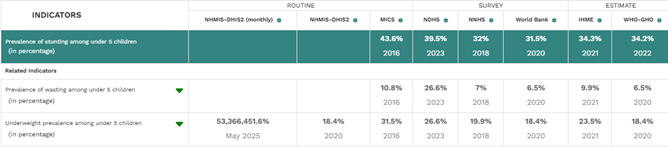
The MSDAT platform is essential because it brings together data from several sources, giving us a clear national picture. As shown in Figure 1 below, the latest National Demographic and Health Survey (NDHS) reveals that Nigeria’s stunting prevalence stands at 39.5%. This rate is nearly double the national target of 20%, signaling a truly significant public health issue across the entire country. But to really see how big this problem is, we need to look closer than just one national number.
The Granular Breakdown: A Story of Varying Severity
When we look beyond the national average, the state-level data reveals a story of deep inequality. A clear pattern of progress is emerging in the South, as shown in Figure 2, where eight states have already dropped below the 20% national target.
This stands in sharp contrast to the North. all northern states remain above the national target line, except for the FCT, which has achieved a similar level of success to the southern states.
However, the most critical insight is not just regional; it is about the scale of the crisis. While a southern state like Ebonyi already requires focused intervention at 31.6%, the rate in Katsina (64.6%) is more than double that figure. This highlights an urgent need for action in most Nigerian states. Furthermore, as shown in Figure 3, every single state is currently performing better than the national value.
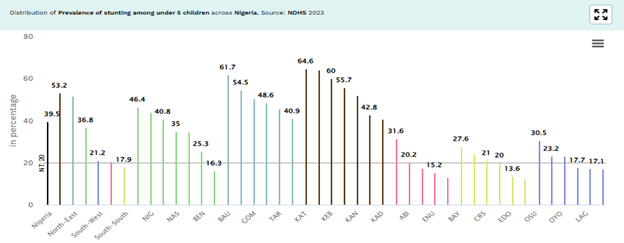
NT signifies the National Target
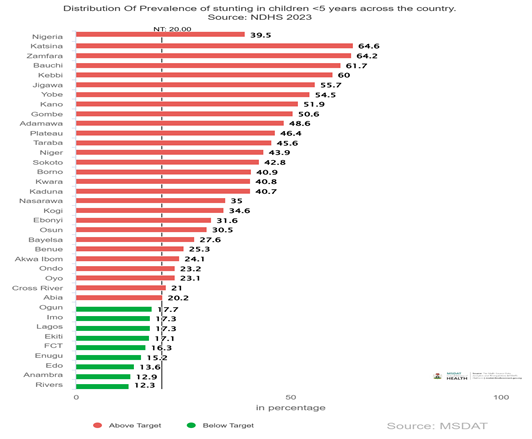
Analyzing the data beyond the national level has helped us to understand a fact: while the country falls below its target for the prevalence of stunting in children under 5, the prevalence of stunting differs from state to state, with some states at extremely critical levels.
- Understanding “High Prevalence”: The data show that the challenge of high stunting rates is not confined to one geographical area. In the South East, Ebonyi has a prevalence of 31.6%, while Kaduna’s value in North Central stands at 40.7%. Both are significantly above the 20% national target and demonstrate a clear need for focused intervention.
- Understanding the Scale of the Crisis: However, the data also highlights that the magnitude of the challenge is not uniform. Although Ebonyi’s rate is alarming, it’s far worse in other states. For instance, Katsina (in the North-West) has a staggering prevalence of 64.6%.
This direct, data-based comparison is crucial. It shows that while multiple states struggle, the level of urgency and the scale of intervention required in a state like Katsina, where the rate is more than double that of Ebonyi, is of a different order of magnitude.
The Core Insight: The Data Demands Targeted, Proportional Action.
The single most important finding from this analysis is this: Nigeria’s stunting problem is not uniform; it is a crisis of varying severity that requires a proportional response.
Averaging the data hides the critical reality: a child in Katsina (64.6%) is more than twice as likely to be stunted as a child in Ebonyi (31.6%), and over five times more likely than a child in Rivers (12.3%).
This insight moves us beyond a simple “North vs. South” narrative and toward a more sophisticated, data-driven strategy. The challenge isn’t just about which states are above the target, but how far above they are. This is the actionable clarity that data provides; it allows us to prioritize resources based on the severity of the need.
Conclusion: From Data to Decision
The Multi-Source Data Analytics and Triangulation Platform (MSDAT) is an innovative tool designed to help health stakeholders in Nigeria move beyond misleading national averages. On MSDAT, you can access data at different levels, including National, Zonal, State, and, in some cases, Local Government values. This data can be used for trend analysis, comparative studies, and other research purposes. It does this by combining and visualizing health data from multiple reliable sources, including routine health systems (DHIS2), national surveys (NDHS), and global estimates into a single, transparent view.
This analytical journey, powered by the MSDAT platform, proves the immense value of drilling into the details. We moved from a single national statistic to a deeper understanding of state-by-state realities when compared with the National Target (NT) and National value. By doing so, we uncovered a clear insight: to fight stunting effectively, resources should be allocated proportionally to the states facing the most severe burden.
Discover these insights for yourself. The power to analyze is at your fingertips.
Explore the MSDAT platform today and begin your analytical journey: https://msdat.fmohconnect.gov.ng/
